Washington Quarter · No Mint Mark · Copper-Nickel Clad
The year silver left American pockets — and a billion-coin mintage hides some surprisingly valuable errors.
1.52B+
Total Minted
No Mark
No Mint Mark Year
$6,250
Top MS67+ Value
5
Major Error Types
The 1967 Washington quarter occupies a defining moment in American coinage history: it was the third and final year that the U.S. Mint struck quarters without mint marks, a policy adopted in 1965 to combat a nationwide coin shortage caused by the surging price of silver. By removing mint marks and transitioning to a copper-nickel clad composition, the Mint hoped to discourage hoarding and stabilize circulation. The PCGS CoinFacts page for the 1967 25¢ provides certified population data, auction records, and in-depth variety analysis for this transitional issue.
For most collectors, a 1967 quarter in circulated condition is worth only a small premium over face value. However, the coin’s enormous mintage means that gem-quality survivors are genuinely scarce in the highest grades, and error coins — particularly SMS pieces with cameo designations and wrong-planchet strikes — can command impressive prices at auction.
Three questions to answer before diving deeper
🔴
Check for a Mint Mark
All genuine 1967 quarters have NO mint mark. If you see a D, P, or S, the coin is a different year — or has been altered.
🟡
Inspect Finish & Strike
SMS quarters show a satin or proof-like surface with sharp design detail. Business strikes look duller. SMS coins in high grades carry a strong premium.
🟢
Look for Errors
Examine under 5–10x magnification. Doubling, missing clad layers, off-center strikes, or copper color can signal a valuable error worth hundreds.
| What You See | Likely Scenario | Estimated Value | Next Step |
|---|---|---|---|
| Proof-like satin finish, sharp strike | SMS Quarter ⭐ | $2–$5,000+ | Grade & authenticate (PCGS/NGC) |
| Strong doubling on LIBERTY or date | DDO variety | $50–$1,000+ | Authenticate, grade & variety-attribute |
| Crescent-shaped blank area on coin | Off-Center Strike | $50–$300+ | Measure % off-center, check date visibility |
| Copper color, smaller or different size | Wrong planchet error | $100–$500+ | Weigh precisely, then PCGS/NGC authenticate |
| Silver surface peeled, copper visible | Missing Clad Layer | $25–$400 | Confirm genuine (not damage), grade |
| Normal clad, worn, circulated | Common circulated | $0.25–$0.85 | Face value or minor collector premium |
One business strike type, one collector SMS issue — no mint marks on either
| Variety | Mint Mark | Mintage | Rarity | Key Notes |
|---|---|---|---|---|
| 1967 Business Strike | None (Philadelphia) | 1,524,031,000 | Very Abundant | MS67+ extremely scarce; top grades command premiums |
| 1967 SMS Quarter | None (San Francisco) | 1,863,344 | Collectible | Proof-like satin finish; Cameo/Deep Cameo most valuable |
The Coinage Act of 1965 authorized the switch from 90% silver quarters to copper-nickel clad coinage, and simultaneously banned mint marks for three years to prevent collectors from targeting coins from specific facilities. 1967 was the last of these three no-mark years. Over 1.5 billion quarters were struck — one of the largest annual mintages in U.S. history — yet finding a perfectly preserved gem example remains a genuine challenge for serious collectors.
Business strike clad quarters — error coins and SMS priced separately below
| Grade | 1967 Quarter Value |
|---|---|
| G-4 (Good) | $0.25–$0.30 |
| VG-8 (Very Good) | $0.30–$0.40 |
| F-12 (Fine) | $0.35–$0.50 |
| VF-20 (Very Fine) | $0.40–$0.60 |
| EF-40 (Extremely Fine) | $0.50–$0.75 |
| AU-58 (About Uncirculated) | $0.75–$1.25 |
| Grade | Business Strike | SMS Quarter |
|---|---|---|
| MS/SP-60 | $1 | $2 |
| MS/SP-63 | $2 | $4 |
| MS/SP-65 | $6 | $12 |
| MS/SP-66 | $20 | $45 |
| MS-67 | $150–$500 | $300–$800 |
| MS-67+ / MS-68 | $1,500–$6,250 | $2,000+ |
| SMS SP-68 Cameo / Deep Cameo | — | $4,700–$5,000+ |
Values are market estimates based on recent auction results and dealer pricing. Consult a professional numismatist for high-value specimens. For a detailed breakdown of 1967 quarter value by variety and grade, the CoinValueApp guide offers current prices updated from live auction data.
A proof replacement struck at San Francisco — and the key to the highest values
★ WHAT IS AN SMS QUARTER?
Because no traditional proof sets were issued from 1965 to 1967, the U.S. Mint created Special Mint Sets as a collector substitute. The 1967 SMS quarter was struck at the San Francisco Mint with specially prepared dies and polished planchets, giving the coins a distinctive satin-to-proof-like surface. They were never released for circulation. SMS coins with strong cameo contrast between frosted devices and mirror fields are the most sought-after and can sell for thousands.
Five major error types — identification tips, values, and photos for each
Doubled inscriptions and date on the front of the coin
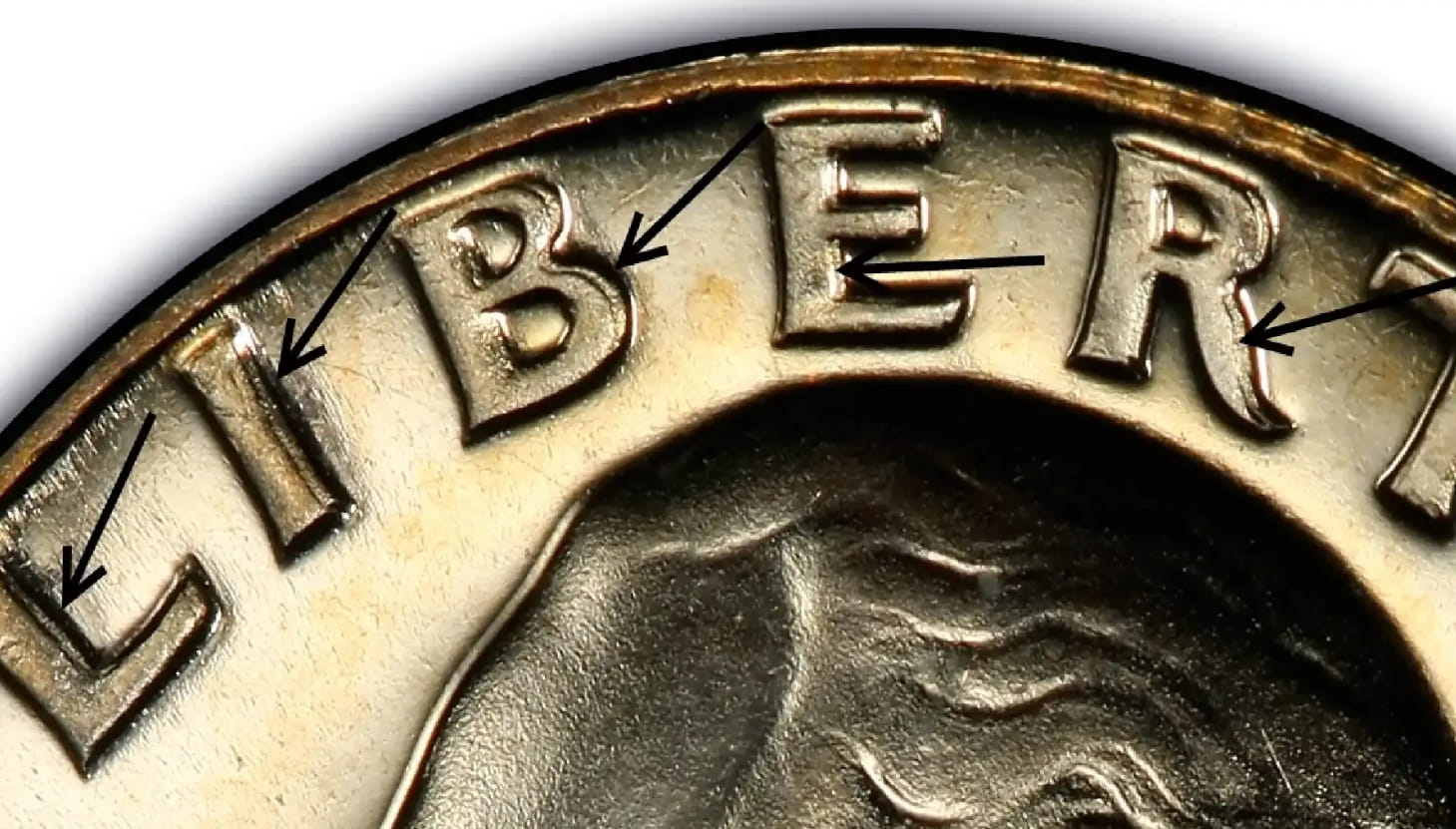
1967 Quarter DDO — doubling visible on LIBERTY and date
The Double Die Obverse error occurs when the die strikes the coin twice in slightly misaligned positions, creating a distinctive doubling effect on the front side of the quarter. This is one of the most sought-after errors among collectors of Washington quarters.
How to identify: Examine the obverse closely under magnification. Look for doubling in the inscriptions LIBERTY, IN GOD WE TRUST, or the date 1967. The doubling typically appears as a shadow or outline next to the original lettering. Washington’s profile may also show slight doubling in hair details or facial features.
Value: $50–$1,000+ depending on severity of doubling and coin grade
Coin blank misaligned during striking — crescent of missing design
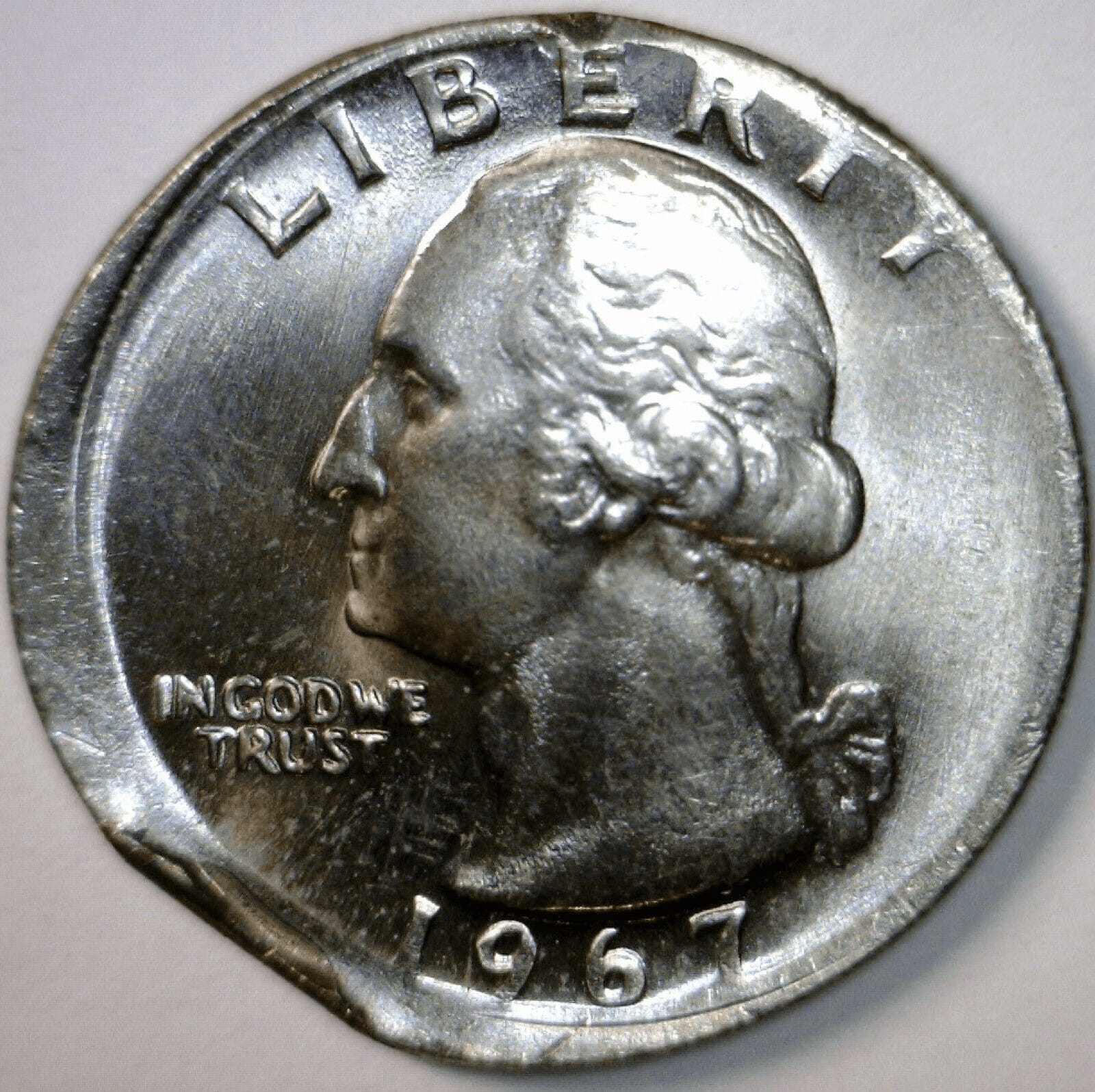
1967 Quarter Off-Center Strike — blank crescent where design is absent
Off-Center Strike errors happen when the coin blank is not properly aligned with the dies during striking. This results in part of the design being missing or cut off, with a corresponding blank area on the opposite side of the coin.
How to identify: The coin shows a crescent-shaped blank area where the design is completely missing. The more dramatic the offset percentage, the more valuable the coin. The date must remain visible for maximum value. Measure the percentage by estimating how much of the design is off the planchet. Coins with 75%+ off-center are extremely rare.
Value: 10–25% off-center: $50–$100 — 50% off-center (date visible): $200–$300+
Quarter die stamps a blank meant for a different denomination
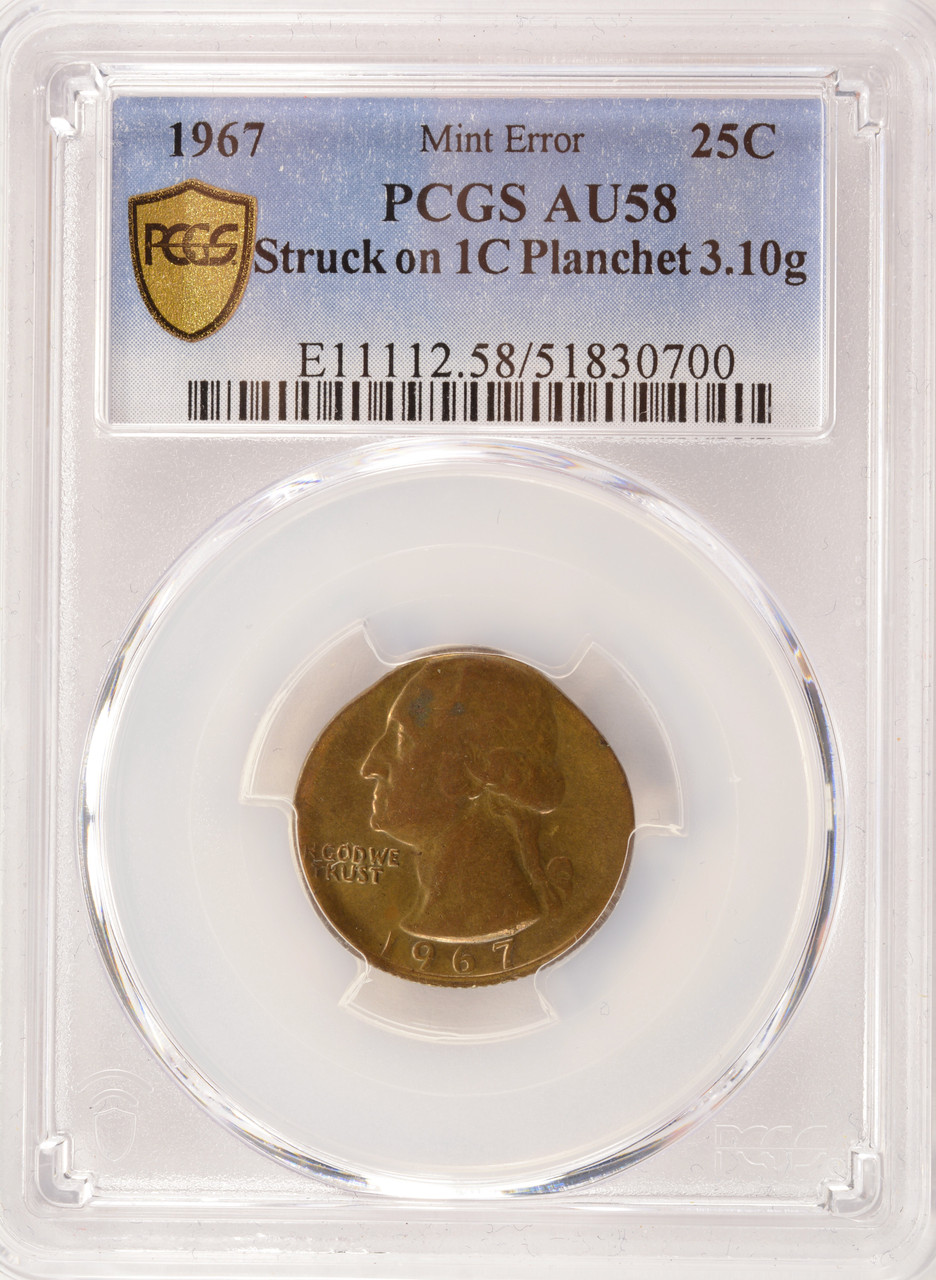
1967 Quarter Wrong Planchet — copper-colored planchet reveals denomination mismatch
This fascinating error occurs when a quarter die accidentally strikes a blank intended for a different denomination. The 1967 quarter can be found struck on nickel, penny, or dime planchets, each creating unique characteristics and visual differences.
How to identify: For nickel planchet errors, the coin is smaller than a standard quarter and parts of the design are missing. Copper planchet errors display a distinctive reddish-brown color. Dime planchet errors are extremely small and rare. Weigh the coin to confirm the wrong planchet type — a standard quarter is 5.67g.
Value: Nickel planchet: $130–$160 — Copper planchet: $100–$300 — Dime planchet: $500+
Missing section of the coin's edge from a blanking punch overlap
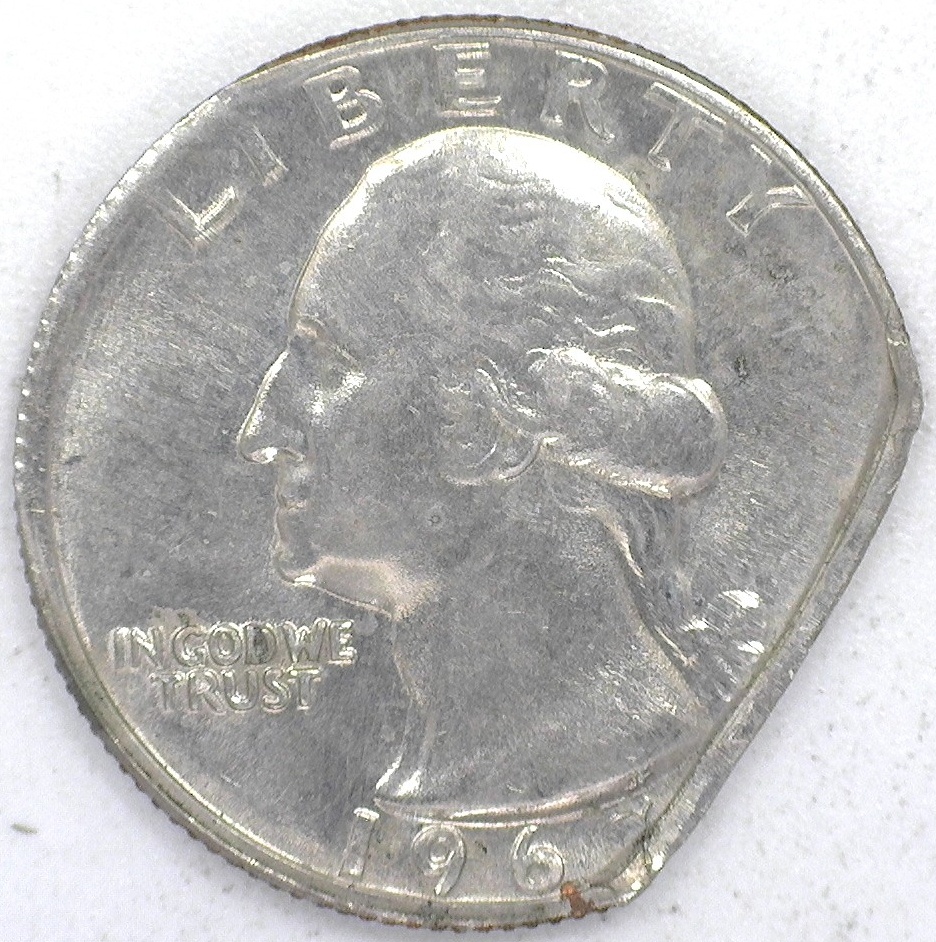
1967 Quarter Clipped Planchet — straight clip along the coin edge
Clipped Planchet errors occur during the blanking process when the metal strip moves incorrectly and overlaps a previous punch. This creates a coin with a missing section along the edge that was never present to begin with — not removed after minting.
How to identify: Look for a clear missing section along the coin’s edge. Straight clips appear as if a portion was cut away with scissors, while curved clips follow the arc of the blanking punch. The clip should show the coin’s interior metal composition with no evidence of filing or post-mint damage. Larger clips are more valuable than small ones.
Value: Circulated: $5–$10 — Uncirculated with significant clip: $50–$100
Copper-nickel outer layer separates, exposing reddish copper core
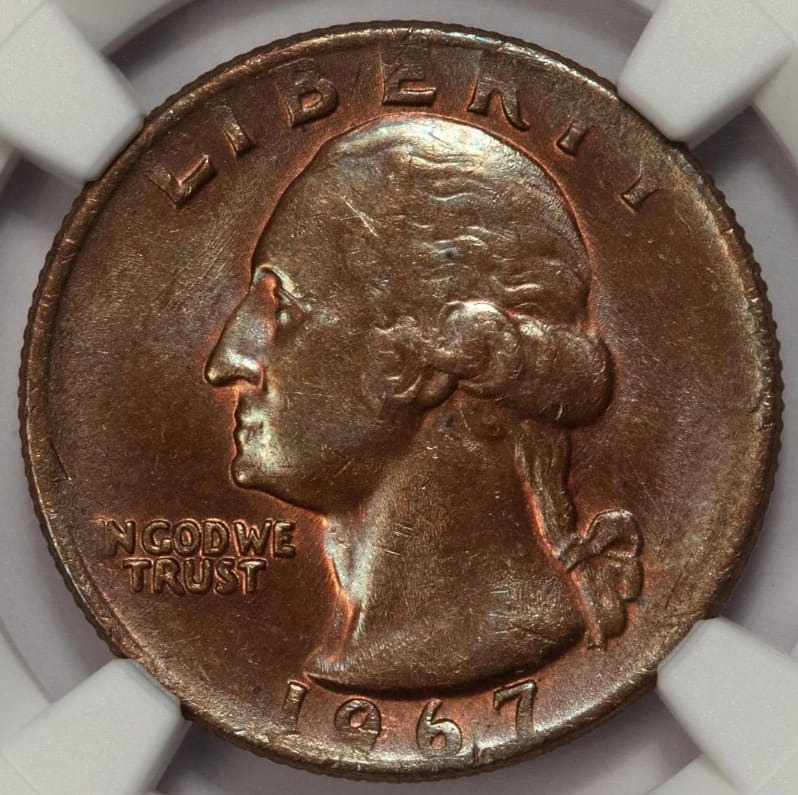
1967 Quarter Missing Clad Layer — copper core exposed on obverse
This error occurs when one or both of the copper-nickel outer layers separate from the pure copper core during the minting process. The exposed copper creates a distinctive appearance unlike normal quarters, ranging from patches of reddish copper to a fully copper-colored coin.
How to identify: Look for areas where the normal silver-colored surface has peeled away revealing reddish copper underneath. The most valuable examples show complete missing clad on both obverse and reverse. Partial missing clad creates a two-tone appearance. The affected areas may feel slightly recessed compared to areas retaining the clad layer.
Value: Partial missing clad: $25–$200 — Complete missing clad (both sides, MS65): $150–$400

Verified public auction records — real market benchmarks for 1967 quarters
| Coin | Grade | Sale Price | Auction House | Date |
|---|---|---|---|---|
| 1967 SMS SP-68 Deep Cameo | PCGS SP-68 DCAM | $4,700 | Heritage Auctions | 2016 |
| 1967 MS-67 | PCGS MS-67 | $6,250 | Heritage Auctions | 2019 |
| 1967 SMS SP-67 Cameo | NGC SP-67 CAM | $1,200 | GreatCollections | 2022 |
| 1967 Missing Clad Layer | PCGS MS-64 | $350 | Heritage Auctions | 2021 |
| 1967 Off-Center Strike (50%) | Raw / VF detail | $225 | eBay verified | 2023 |
“The 1967 quarter is proof that enormous mintages don’t guarantee availability in top grades — finding a fully struck MS-67 from 1.5 billion coins is a genuine challenge that the market rewards handsomely.”
Detect DDO doubling, SMS varieties, clad layer errors, and off-center strikes in seconds
Snap Both Sides
CoinKnow instantly identifies the 1967 Washington quarter, flags SMS vs. business strike finish, and detects surface abnormalities that signal valuable errors.
Detect Errors & Varieties
Automatic detection for DDO hub doubling vs. machine doubling, off-center strike percentages, missing clad layers, and wrong planchet candidates.
Get Instant Value
Sheldon Scale grade estimate, SMS designation check, and real-time auction comparisons from Heritage Auctions and GreatCollections.
How much is a 1967 quarter worth?
Most circulated 1967 quarters are worth $0.26 to $0.85. Uncirculated examples range from $1 to $12.50. High-grade MS67+ specimens can reach $6,250, and 1967 SMS quarters in exceptional condition with deep cameo contrast have sold for up to $4,700.
Why does the 1967 quarter have no mint mark?
The U.S. Mint eliminated mint marks from 1965 through 1967 to discourage coin hoarding during a nationwide shortage caused by rising silver prices. All 1967 Washington quarters were struck without a mint mark regardless of which facility produced them.
What is a 1967 SMS quarter?
The 1967 Special Mint Set (SMS) quarter was struck at the San Francisco Mint for collectors instead of traditional proof sets. These coins feature a superior finish with frosted devices and mirror-like or satin fields. SMS quarters with cameo or deep cameo designations can be worth $500 to $5,000+.
What 1967 quarter errors are most valuable?
The most valuable 1967 quarter errors include: Struck on Wrong Planchet ($100–$500+), Off-Center Strike ($50–$300+), Double Die Obverse ($50–$1,000+), Missing Clad Layer ($25–$400), and SMS quarters with deep cameo designation ($4,700+). Use CoinKnow to identify and value your error coins.
How do I verify my 1967 quarter error is authentic?
Authentic errors show specific characteristics: consistent patterns, proper metal flow, and absence of tool marks. Professional grading services like PCGS and NGC can authenticate errors. For quick verification at home, CoinKnow provides expert analysis and helps distinguish genuine errors from post-mint damage or alterations.
The 1967 quarter is a coin of contradictions: minted by the billions, yet genuinely rare in gem condition; composed of ordinary copper-nickel, yet capable of commanding thousands of dollars when struck with errors or in exceptional SMS quality. For most collectors, it’s an affordable entry into Washington quarter collecting. But for those who look carefully under magnification, the 1967 quarter offers a surprising breadth of varieties and errors that make it far more rewarding than its face value suggests.
“The 1967 quarter is the last coin of the no-mint-mark era — a transitional piece that bridged silver coinage and the modern clad age, and produced some of the most interesting error coins of its decade.”